Tonda PF Xiali Calendar, World premiere with full calendar in China
More than just a calendar, Xiali is an ode to the calendars and civilizations of the world through Swiss mechanical art, so dear to Parmigiani Fleurier since its foundation.
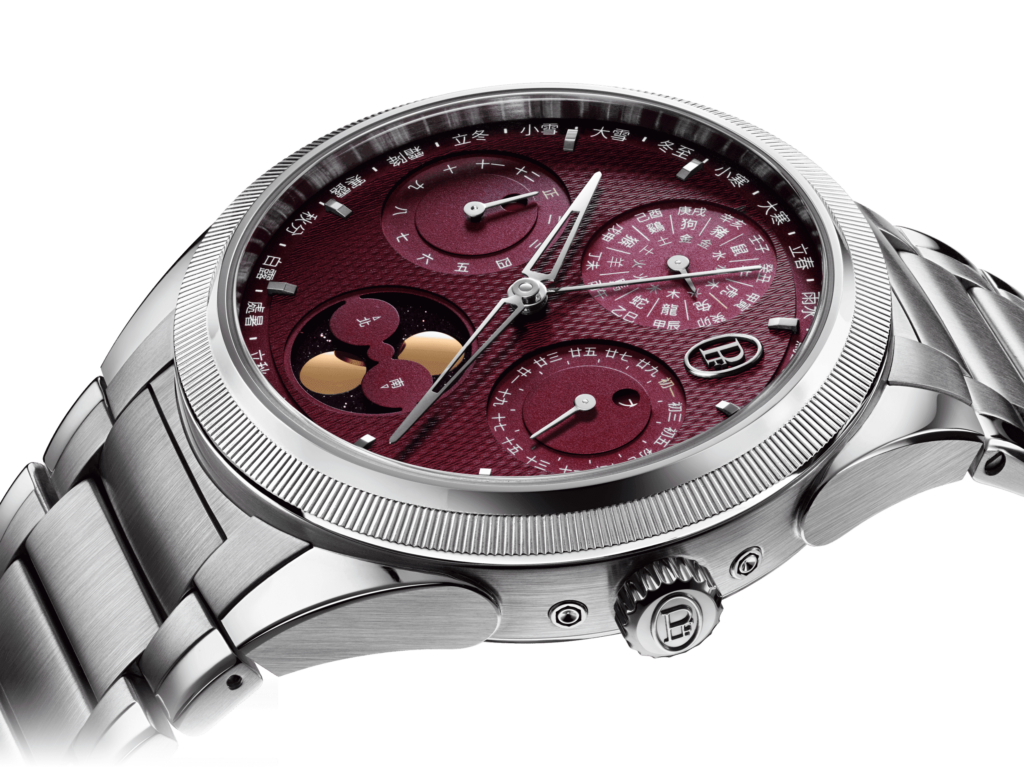
Xiali: Chinese traditional full calendar
Throughout history, man has sought to control time, predict and chart its flow in order to better organize the rhythm of social, religious and agricultural life.
The universal calendar allows us to determine dates that are recorded as milestones over time.
We have long been fascinated by this cultural phenomenon and present the Tonda PF Xiali calendar, an extremely complex creation that follows the Gregorian and Muslim calendars designed by our Maison.
Calendar functions are among the most fascinating, mirroring civilizations and societies, vessels of faith, and indefinable phenomena such as the movement of shadows, the alternation of the seasons, and the mysteries of the lunar cycle. Together, such phenomena play a vital role in human activity.
Calendars are the radiography of civilizations. This is something magical, because the calendar comes from observing both people and nature. By observing nature, you can travel through history and track the development of civilizations. Calendars were born out of the need to understand the seasons of nature and anticipate the phenomenal nurture of nature.
– Michel Parmigiani, founder and master of watches.
A deep dive into Sleep:
Chinese Traditional Full Calendar
The Chinese calendar is complex because it combines elements of both the solar and lunar calendars, which are calculated separately and then synchronized.
This is achieved by adding an additional lunar or intermediate month. This 13th month, which allows the two cycles to coincide, occurs approximately every three years.
The Chinese calendar divides the solar year into 24 solar terms or breaths, which symbolize the agricultural calendar.
The New Year appears according to the exact rules and takes the name of the month that precedes it.
The calculation is complicated, but it allows us to keep track of the seasons and set the Chinese New Year at the arrival of spring, which varies from the end of January to the end of February in our calendar – from January 21 to February 19.
Unlike the Gregorian calendar, which names months and years, the Chinese calendar names lunar years and the number of months.
The names of the years are repeated in a 60-year (sexagesimal) cycle, but the calendar, which includes dates, days, and months, is calculated based on astronomical observations and varies. Since these calculations vary, it is impossible to create an “eternal” Chinese calendar.
Our creation goes as far as possible in creating the most complete and accurate Chinese calendar in the form of a clock.
The numbering system of time units is based on a combination of the decimal cycle, the ten heavenly stems, and the twelve-decimal cycle, the twelve earthly branches.
The 10 celestial stems perform the function of assigning the elements of time to the years and planets – water, wood, metal, fire, and earth. The 12 earthly branches correspond to the signs of the zodiac: each of them is represented by an animal, which marks the years of the sexual cycle and will influence the fate and character of people born this year.
We managed to condense all this complex information on the dial: hours and minutes; month display and numbering; additional month, when applicable (i.e. every three years); short month (29 days) or long month (30 days); solar terms corresponding to 24 divisions of the 15° path of the sun along the ecliptic (tra
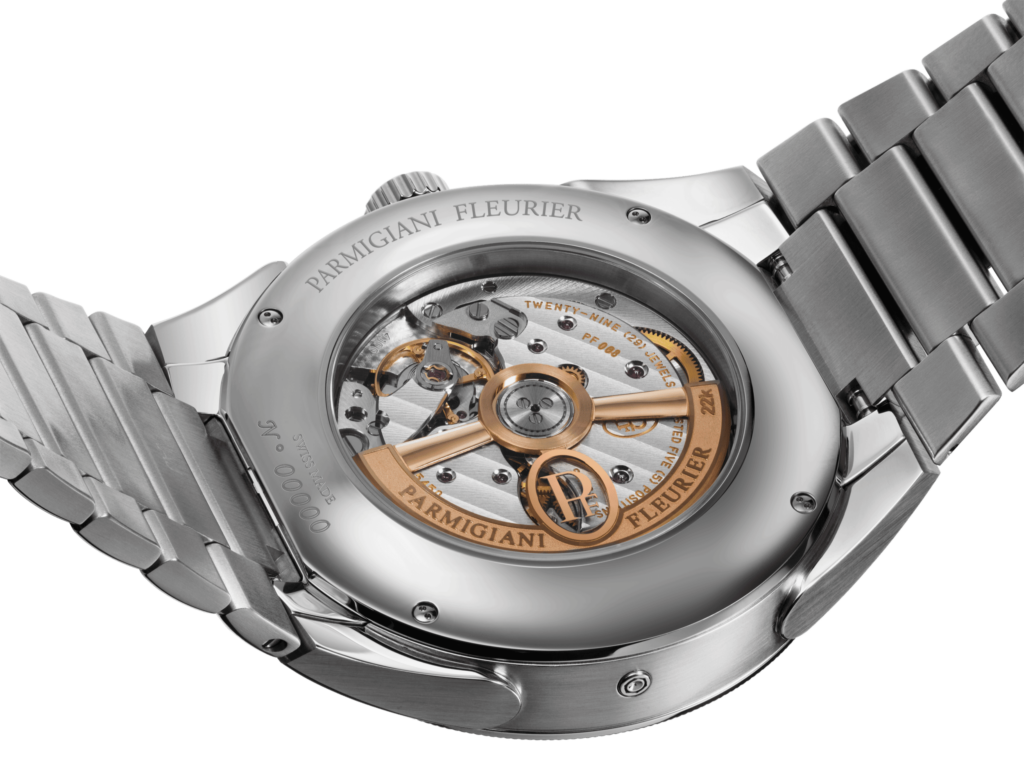
All information and adjustments are made quickly thanks to the various correctors located on both sides of the case in the middle. The watch hides an extremely complex mechanism in the new Calibre PF008 mechanism, which allows you to display this information in classical Chinese characters. Since the Chinese calendar is not cyclical, the complication is mechanically programmed and covers a period of 12 years using a cam system.
Imperial purity
In addition to extending the calendar theme so dear to our Home, the Tonda PF Xiali calendar also enhances the sartorial codes of the Tonda PF collection. The whole process of designing and designing this watch was a balancing act.
Complication does not necessarily mean complexity. The task of creating such a calendar has been brought down to the smallest detail, while ensuring compliance with the codes of the Tonda PF collection.
The multilevel dial with applications of 18-carat white gold with rhodium plating and skeletonized hour and minute hands is made in imperial red with a Guilloche pattern “barley”, enhancing its surface.
The stainless steel case features a fluted 950 platinum bezel, while the integrated bracelet made of the same material promises comfort and elegance on the wrist. As usual, the back covers are open to show the movement and its decorations through the sapphire crystal.
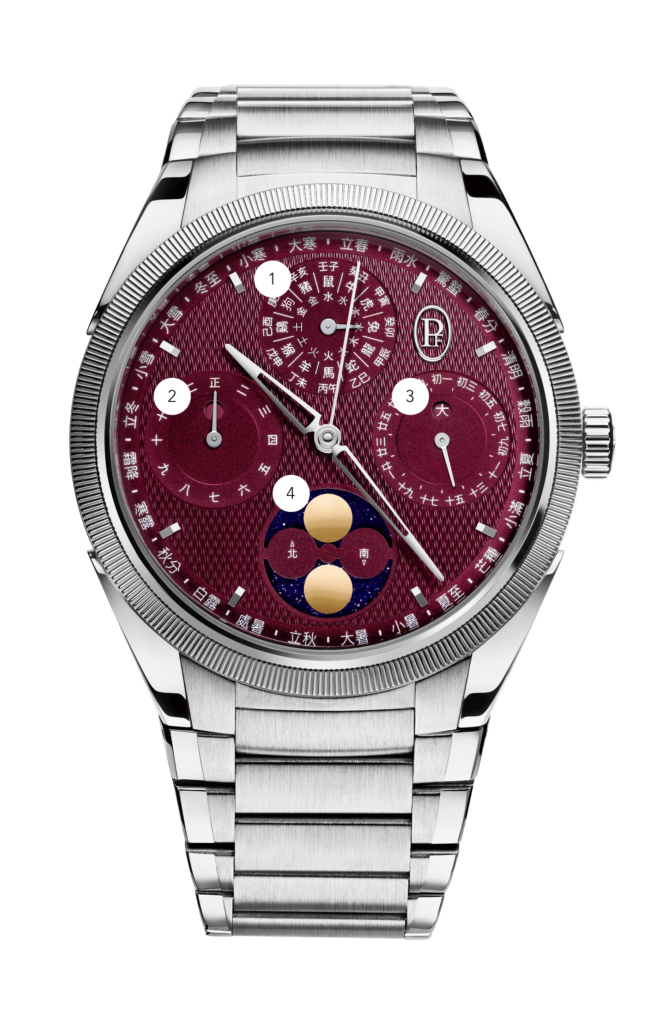
1. Subdiferal at 12:00
1st level: name of the year
2nd level: Animal
3rd Level Element + yin/yang
2. Subdial recruitment at 09:00
Month number (from 1 to 12)
3. Subdiabulation at 03:00
The number of the day and an indication if today is a long or short day
4. Subdiabulation at 06:00
Moon phase Indication
FULL CHINESE CALENDAR, MOON PHASE INDICATOR
Power reserve: 54 hours
Frequency: 28,800 Per hour (4 Hz)
Jewelry: 42
Number of parts: 353
Diameter: 32.6mm
Thickness: 6.9mm
Decoration: Côte de Geneva, chamfered bridges
Oscillating weight: 22-carat rose gold, skeletonized, polished and sandblasted
Polished and satin-finished stainless steel with platinum 950 bezel
Diameter: 42mm
Thickness: 12.2mm
Crown: Ø 6 mm, screw-in
Glass: anti-reflective ARunic sapphire
Case: Sapphire crystal
Engraving on the back of the case: serial number – “PARMIGIANI FLEURIER”
Water resistance: 100 m
Color: Imperial Red
Finish: Grain d’Or guilloché
Indexes: applications of 18k gold with rhodium plating
Moon Phase: Blue Aventurine
Hours and minutes: 18-carat gold rhodium-plated skeleton
Seconds and calendar: rhodium-plated steel
Polished and satin-finished stainless steel
Closure: Stainless steel folding clasp
24 solar terms:
- The beginning of spring (lì chun)
- Rainwater (yu shui): Precipitation and temperature rise. Buds are beginning to cover the landscape, river ice is melting, wild geese are migrating from south to north, trees and grass are turning greener.
- Insect Awakening (Jing je): The surge of spring, which revives insects and wakes wintering animals from sleep, marks the peak of spring agricultural activity.
- Vernal Equinox (chun fen): The day when the sun is directly above the equator, creating equal lengths of day and night before it moves north, resulting in a gradual lengthening of days in the northern hemisphere and nights in the southern hemisphere.
- Pure brightness (Qing ming)
- Grain Rain (gu yu): Early crops begin to show their shoots, according to the proverb that “rain makes hundreds of grains grow,” making this an important harvest period.
- The beginning of Summer (li xia): Today, the sun’s rays are at an angle of 45 degrees to the Earth. Temperatures are rising rapidly in southern China, but the weather remains mild in northern China.
- Small full (grain) (cao) grain buds: The grains are beginning to ripen, but have not yet reached maturity.
- Grain in the ear (máng zhong): The maturation of crops such as barley and wheat encourages farmers to start summer planting.
- Summer Solstice (xià zhì): The longest day and the shortest night: at this time, most of the northern hemisphere receives many hours of sunshine without the highest temperatures, which will occur only after 20-30 days.
- Minor heat wave (Xiao shu): The hottest period continues, but the extreme heat has not yet arrived.
- Intense heat: At this time, most areas of China are entering the hottest season of the year, with temperatures in many cities reaching over 35 degrees.
- The beginning of autumn (lì qiu): Summer is over, and the season of abundance is approaching.
- Heat Limit (chi shu) The end of the heat: Most parts of China say goodbye to the summer heat and enter autumn.
- White dew (bái lù): the true beginning of autumn coolness: the temperature gradually drops, and the water vapor in the air condenses into white dew that covers the grass and trees at night.
- Autumnal equinox (qiu fen): After this day of equal length, day and night, which divides autumn into two equal parts, direct sunlight radiation moves south; in the northern hemisphere, the days become shorter and the nights longer.
- Cold dew: Temperatures are currently much lower than during white dew in most areas of China. The dew is thicker and colder, and the rain is tapering off.
- Frost descent (shuang Jiaang): The last sunny term of autumn is characterized by the fact that the weather becomes much colder, and frosts form in the north.
- The beginning of winter (lì dong) The beginning of winter: Winter is coming, and farmers are bringing in the autumn harvest.
- Light snow (xiao xue): Snow is starting to fall, mainly in northern China, and temperatures are continuing to drop.
- Big Snow (dà xue): Snow is getting deeper and heavier, accumulating on the ground as temperatures drop to near freezing in northern China.
- Winter Solstice (dong zhì): The daytime hour of the solstice is the shortest, and the night hours are the longest.
- Minor cold (Xiao Han): Most of China is entering a phase of severe winter cold. The land and rivers are frozen. The cold air from the north extends to the south.
- Severe cold (da khan): In the last solar semester of the lunar calendar, snow, rain and frosty weather strongly affect people’s lives.
Source: https://parmigiani.com/en/watches/tonda-pf-xiali/


Categories
- A. Lange & Söhne
- Audemars Piguet
- Bovet
- Breguet
- Breitling
- Bvlgari
- Cartier
- Chanel
- Chopard
- Damiani
- De Bethune
- De Grisogono
- Diamond
- Frederique Constant
- Gerald Genta
- Girard-Perregaux
- Greubel
- Hublot
- IWC
- Jacob & Co.
- Jaeger-LeCoultre
- Louis Moinet
- Omega
- Panerai
- Parmigiani
- Patek Philippe
- Piaget
- Richard Mille
- Roger Dubuis
- Rolex
- TAG Heuer
- Ulysse Nardin
- Vacheron Constantin
- Van Cleef & Arpels
- Zenith
- Reviews
We use cookies to improve the website. By agreeing, you allow their use in accordance with our terms. More details in our Privacy Policy.
We respect your choice and will not use cookies without your consent.]
However, without cookies some website features may be limited. Cookies help:]
- maintain stable website operation;]
- analyze user behavior and improve service;]
- show personalized offers.]
If you change your mind, you can always update your decision. More details in our Privacy Policy]