This year, the Swiss watch brand Breitling celebrates 140 years since its foundation. As part of the anniversary, the company presented 3 new items from the Navitimer collection: Navitimer GMT, Navitimer Automatic 41 and the limited edition Navitimer Cosmonaute model with a 24-hour scale.

Breitling Navitimer: history
This year marks the 140th anniversary of the Breitling brand, and it celebrates this event on a grand scale, starting with numerous incredible new products. We have already got acquainted with one of them, dedicated to the first non-stop balloon flight, the Breitling Aerospace B70 Orbiter: around the world in 19 days. In the same month, the brand rethinks two of its icons at once: the Navitimer, the first wristwatch for pilots that combines a chronograph and a computational slide rule, and the Cosmonaute (the 24-hour version of the Navitimer), the first Swiss watch to travel in space.
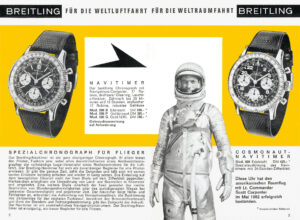
The history of the latest model is known for a remarkable fact: the watch was commissioned by American astronaut Scott Carpenter, who asked to be equipped with a 24-hour scale to distinguish day from night. On May 24, 1962, as part of a space mission aboard the Mercury-7 spacecraft, this chronograph became the first Swiss-made watch to fly into space.
Breitling has just introduced new versions of the legendary Navitimer GMT and Automatic 41 lines, as well as the new self-winding Cosmonaute model. But first, let’s remember how it all started.
“This year we will be talking about the 140th anniversary of our brand,” says Georges Kern, CEO of Breitling. “And when it comes to these two watches – the Navitimer and the Cosmonaute- it’s impossible to overestimate the importance they had for the company, aviation, and watchmaking in general.”

Breitling played a key role not only in space exploration, but also in the emergence of commercial flights. On-board clocks have become standard equipment in the aircraft of the world’s leading aircraft manufacturers. When the first Breitling Navitimer wristwatch appeared in 1952, it immediately became a hit among pilots in the then-nascent field of civil aviation.

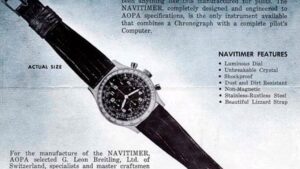
The first Navitimer had a round slide rule that allowed pilots to make important calculations: climb rate and fuel consumption. It can be considered that the Navitimer became the first “on-board computer” that pilots wore on their wrists, and which eventually made Breitling the “official supplier of global aviation.”
As civil aviation expanded, Navitimer’s fame grew, attracting not only pilots but also trendsetters such as Miles Davis and Serge Gainsbourg. The brand has become a favorite and popular not only among pilots, but also among representatives of pop culture.
“After 70 years, the Navitimer has ceased to be a watch used only by pilots and astronauts. They have become a symbol for those who plan their own way of life.”
Navitimer Automatic 41
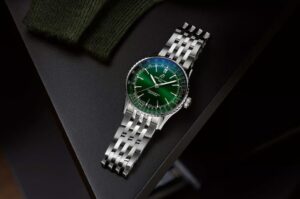
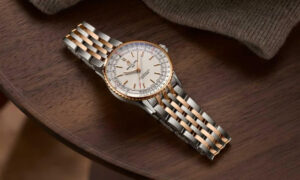
Breitling began upgrading the Navitimer line back in 2022, gradually changing the classic version. Today, the company continues to implement its plans, releasing 2 limited collections at once: Navitimer Automatic 41 and Navitimer Automatic GMT 41.
The new Navitimer Automatic 41 model is distinguished primarily by the harmonious design of the dial, which immediately attracts attention: the novelty lacks a date aperture, which makes it more refined and “lightweight”. Design optimization can also include eliminating the chronograph function and turning only the tip of the second hand red instead of using contrasting hands completely, which also overload the appearance of the watch.
Another notable feature is the scalloped bezel, which is a reference to vintage Navitimer watches from the collection’s beautiful past.

Breitling has also improved the minute scale, dividing each minute into four segments to read the time more accurately. The internal mechanism, the Breitling 17 caliber, oscillates at a rate of 28,800 half-vibrations per hour, which corresponds to a frequency of 4 Hz, so the balance makes four vibrations per second. And since the second hand moves smoothly on the dial, you can always distinguish the passing time with perfect clarity with an accuracy of 1/8 of a second.
 Despite the innovations, the designers tried to preserve the key features of the models – the simplified Breitling logo, sword-shaped hands and faceted indexes with SuperLumiNova coating, clear dials and the traditional color palette: blue, green or light blue dial color for the models stainless steel, or silver for steel and gold models and 18k rose gold models.
You can also choose from an alligator leather strap with a folding clasp or a branded Navitimer bracelet with a butterfly clasp.
Navitimer Automatic GMT 41
The Navitimer Automatic GMT 41 continues the updated aesthetic of the Navitimer Automatic 41. The colors of the models clearly show the desire for modernity.
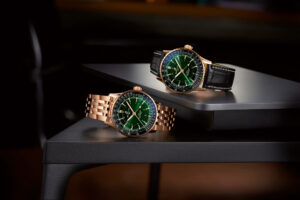
The watch is available in 4 versions: with a black, silver or blue dial in a stainless steel case or with an emerald dial in a bright 18K rose gold case. The dials feature the same familiar Breitling B logo just below the 12 o’clock mark. Thanks to the GMT function, these models are equipped with an additional arrow with a noticeable triangular part at the end to maximize the difference from the other three arrows. Here we must pay tribute to Breitling – they managed to integrate an additional 24-hour GMT dial as elegantly and unobtrusively as possible. The GMT hand can be set separately from the others by turning the crown clockwise in one-hour increments.

Inside the watch is the Breitling 32 caliber, based on the COSC-certified ETA 2892-2 caliber with an individual rotor. Turning the crown counterclockwise allows you to adjust the date – yes, it is present on this model, but also very imperceptibly and unobtrusively – it is located at 6 o’clock.
Like the Navitimer Automatic 41, this model is also available in an alligator leather version with a folding clasp or in a Navitimer bracelet with a butterfly clasp. Both models are completely gold-plated and have the Origins label, indicating that the gold mining for the watch was carried out in accordance with the environmental and social standards of the Swiss Better Gold Association.
Navitimer B12 Chronograph 41 Cosmonaute
A typical watch for adventurers, the Navitimer is not only suitable for aviation. They traveled beyond our planet and became the first Swiss wristwatch in space. Mercury Seven astronaut Scott Carpenter wore them during the completion of America’s second orbital space flight during the Mercury-Atlas 7 mission on May 24, 1962.
It was Carpenter who asked Breitling to modify the Navitimer for space exploration, as a result of which the new 24-hour dial made it possible to clearly distinguish day from night in orbit. As a result, this watch was named Cosmonaute, and this year it once again found itself in the spotlight as part of Breitling’s birthday celebrations.
The only watch in the new line with a chronograph function, the Navitimer B12 Chronograph 41 Cosmonaute Limited Edition is a limited edition model with only 250 copies. Inside it is a B12 caliber movement, which makes this model a self-winding watch, unlike the latest version with manual winding and B02 caliber.
The watch is made of 18K rose gold, which is beautifully set off by a deep green dial with elegant black chronograph counters and gold indexes in the classic 24-hour Cosmonaute format. The set includes a spectacular black alligator leather strap with a folding clasp made of red gold.

Fans of the brand will also love the AOPA logo, which refers to the original Navitimer models created for the Aircraft Owners and Pilots Association.Through the transparent back cover, you can see the B12 caliber, the engraving One of 240 and the inscription “The first Swiss wristwatch in space / Navitimer Cosmonaute, May 24, 1962.”



- A. Lange & Söhne
- Audemars Piguet
- Bovet
- Breguet
- Breitling
- Bvlgari
- Cartier
- Chanel
- Chopard
- Damiani
- De Bethune
- De Grisogono
- Diamond
- Frederique Constant
- Gerald Genta
- Girard-Perregaux
- Greubel
- Hublot
- IWC
- Jacob & Co.
- Jaeger-LeCoultre
- Louis Moinet
- Omega
- Panerai
- Parmigiani
- Patek Philippe
- Piaget
- Richard Mille
- Roger Dubuis
- Rolex
- TAG Heuer
- Ulysse Nardin
- Vacheron Constantin
- Van Cleef & Arpels
- Zenith
- Reviews