The Omega Constellation family of watches is one of the oldest in Omega production after World War II. The Constellation collection predates the Speedmaster and came out just a few years after the first Seamaster, when the first Constellation watches were released in 1952. This watch, with its distinctive dials, is one of the most aristocratic watches any company has ever produced.
Since then, the Constellation family has undergone several metamorphoses. One of the most significant changes was the introduction of new timekeeping technology, and the first Constellation quartz models – three of them – debuted at Baselworld in 1970.
In 1982, the designer of Omega Carol Diedisheim, who started working at Omega in 1980, came up with a model whose descendants are still with us. The Manhattan line debuted a number of distinctive design features. The case was built around an ultra-thin quartz calibre of 1422, and the watch had a built-in bracelet with rounded links, as well as a dial with Roman numerals that were not applied to the dial itself, but were actually painted on the underside of the glass to reduce its height.

The most noticeable were the four brackets on the body, which were located at 3:00 and 9:00. Although nowadays it is often assumed that they are decorative, in fact they were of a technical nature – a solution to the problem of how to make the watch thinner by eliminating the bezel.
The staples were actually clips secured from below with screws that passed through the back of the case. They were used to compress the gasket on the back of the case and glass to improve water resistance. The idea to use staples to hold the glass in place came to the then Omega product director, Pierre Andre Ellen, during his morning shave, when he noticed that his unframed bathroom mirror was held to the wall by eight clips.

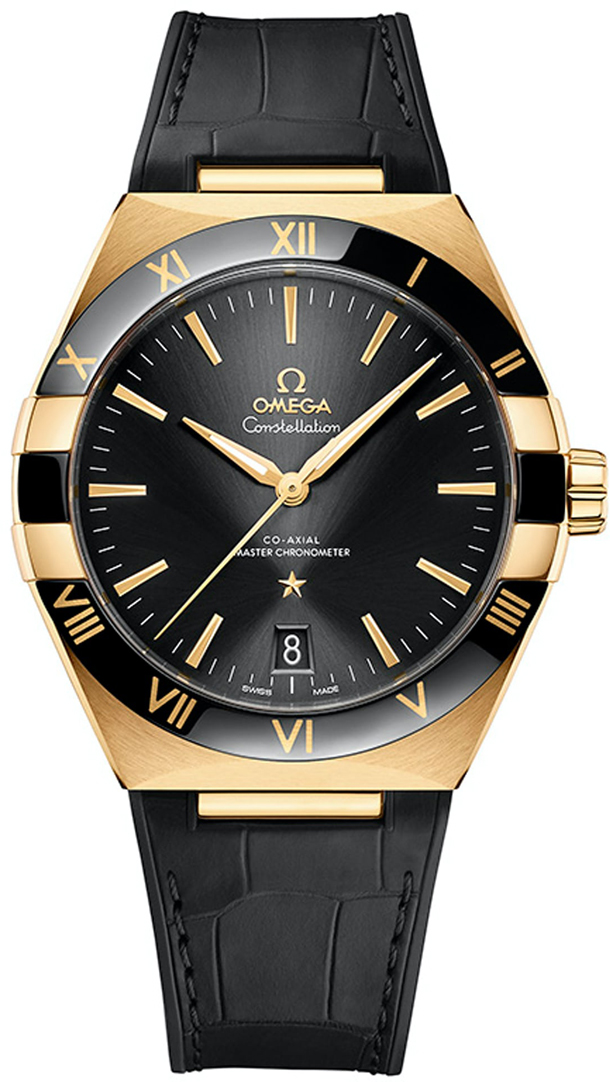
This know-how is no longer installed on the case in the latest Constellation models, they are still present as visual elements embedded in the ceramic bezel of the 41mm model.
The original Manhattan also had an articulated link, an integrated wristband – actually a 1969 Constellation model. Despite the fact that the Manhattan models had a quartz movement, it was of high quality. The Omega 1422 caliber, which was certified as a chronometer, worked on 7 stones and had a trimmer for fine tuning.

Omega has already announced an update to the Constellation line in the 36mm and 39mm models, and the same aesthetic updates applied to these lines are present in the new 41mm models. These include: a new dial, whose profile, according to Omega, is inspired by the Manhattan skyline in general and the Freedom Tower of the World Trade Center. Indeed, the conical arrows resemble the elongated triangular faces of the actual building – also an homage to the original 1982 Manhattan Constellation model, whose design has since become the basis of Constellation models.

The new 41mm models also retain the staples, which are probably the most beloved element of the Constellation watch. As already mentioned, the staples were a technical feature in the original Constellation Manhattan, and in the current collection, including all new models, they are more decorative than practical elements that serve to visually connect modern watches with the original ones from 1982.
The brackets in the new Constellation models are now all flush with the bezel (they protruded noticeably beyond the edge of the bezel in previous Double Eagle models), and look best in contrasting material. This applies to some extent to all new 41mm models.

The ceramic bezel is quite difficult from a technical point of view, since the ceramic material changes its physical size during baking, and the brackets should easily fit into the recesses. After the bezel is ready, indentations for Roman numerals are cut into it using a laser, and then they are filled with a gold alloy. Then the entire bezel is brushed, and since the ceramic is harder than gold, the numbers are matte, but the ceramic remains intact.

The watch uses an Omega movement of Caliber 8900 or 8901, depending on the model. They are technically identical; the 8901 is the gold-rotor version, and it is mainly used in Omega watches made of precious metals. Both are powered by 39 stones with a 60-hour power reserve. The mechanisms use coaxial escapements, silicon balance springs and the ability to withstand magnetic fields up to 15,000 gauss. The calibres are certified by the Master Chronometer.
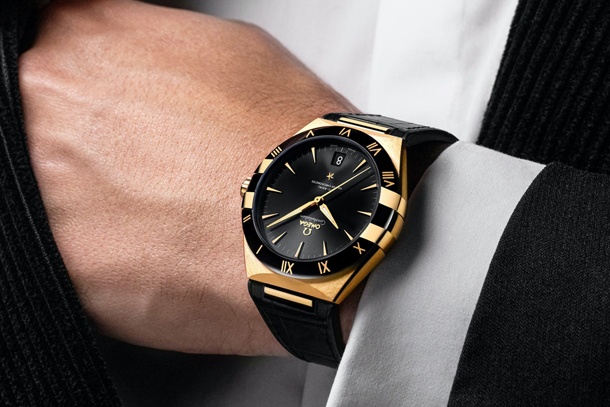
Coaxial escapement and Master Chronometer certification are increasingly used throughout Omega production, with some exceptions in the form of quartz models and, of course, Moonwatch. The Master Chronometer mechanisms are the most advanced mechanisms Omega has ever made. They offer long-term precision in timekeeping, as well as reliability and durability that very few of the company’s competitors approach.
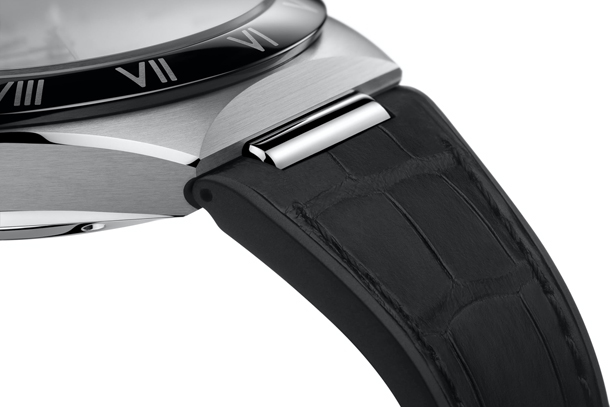
The use of ceramics at Omega has reached such an extent that their watches have a continuous connection between the attractiveness of ceramics in terms of its technical properties and aesthetics, and the Constellation watches give a very pleasant impression of careful attention to detail.
The Constellation collection watches offer an interesting design, excellent movements with proven timekeeping characteristics and the opportunity to purchase something that is of real interest in terms of the evolution of watchmaking at Omega in the 20th and 21st centuries.
Technical specifications
Omega Constellation Co-Axial Master Chronometer 41 mm
| The building |
| The mechanism |


- A. Lange & Söhne
- Audemars Piguet
- Bovet
- Breguet
- Breitling
- Bvlgari
- Cartier
- Chanel
- Chopard
- Damiani
- De Bethune
- De Grisogono
- Diamond
- Frederique Constant
- Gerald Genta
- Girard-Perregaux
- Greubel
- Hublot
- IWC
- Jacob & Co.
- Jaeger-LeCoultre
- Louis Moinet
- Omega
- Panerai
- Parmigiani
- Patek Philippe
- Piaget
- Richard Mille
- Roger Dubuis
- Rolex
- TAG Heuer
- Ulysse Nardin
- Vacheron Constantin
- Van Cleef & Arpels
- Zenith
- Reviews