When you hear the word Omega, the first thing that comes to mind is the Speedmaster, followed by the Seamaster and other technically advanced sports watches. The last thing you think about is the tourbillon. However, Omega’s history is rich in early models of tourbillon watches released in the 1940s. At that time, the tourbillon was not a visual decoration. He was the subject of experiments to improve timekeeping.
The first generation of Omega tourbillon watches is almost never found on sale or at auctions. But when they appeared at the Phillips auction in 2017, they were bought for a rather impressive sum of 1,428,500 Swiss francs.
The tourbillon wristwatches made in the 1940s used a .30 I caliber, and they weren’t made for sale-rather, they were designed to compete. They had tourbillons that rotated quite unusually once every seven and a half minutes, and at one time they were the last word in the search for cutting-edge timekeeping.

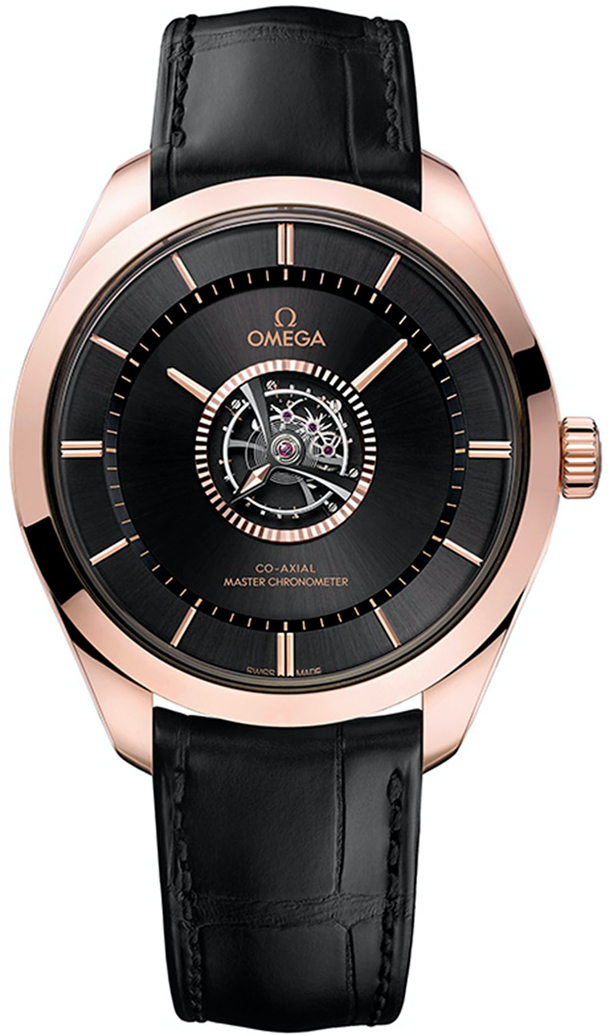
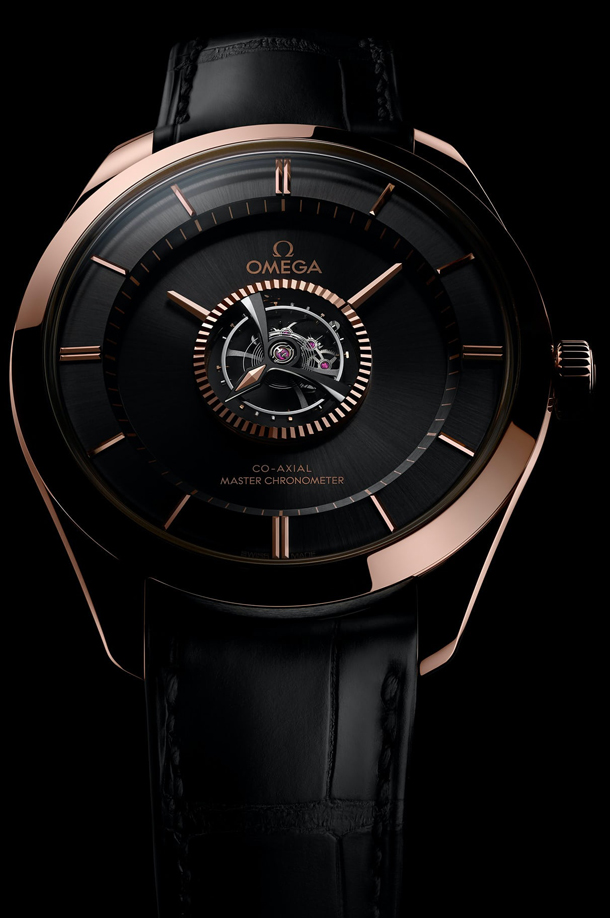
Omega today unveiled another milestone in both its own tourbillon manufacturing history and in the history of tourbillon watches in general – the new Omega De Ville Tourbillon Numbered Edition, which is capable of withstanding magnetic fields of at least 15,000 gauss. This latest version of the Omega Central Tourbillon has a three-day power reserve and a coaxial descent.
The Central Tourbillon was first introduced into the De Ville watch family by Omega in 1994. It was both a remarkable achievement and a statement of purpose for one of the largest and most important Swiss watch brands. Omega emerged from the Quartz crisis, having lost most of its internal experience in the manufacture of mechanisms, but the company decided to prove itself in this field again. The 1994 De Ville Central Tourbillon demonstrated its determination to make the technical excellence of Omega watchmaking the theme not only of its past, but also of its future.
The original De Ville Central Tourbillon was a wristwatch in which the tourbillon cage is located in the center of the movement, rather than in the more usual place at around 6 o’clock. The project began in 1991, codenamed Project 33 (P33) by Moritz Grimm and Andre Beiner of Omega. The team had only three years to produce the watches, as they were supposed to make their debut in time for Omega’s 100th anniversary in 1994.
The biggest technical problem was that the watch’s hands, as a rule, were mounted on hinges located in the center of the mechanism, and the location of the central tourbillon made this impossible. However, a solution was found to install the hour and minute indicators on two sapphire discs.
The project was eventually completed by the 100th anniversary of Omega’s birth and was released in a De Ville case with a central tourbillon and a Caliber 1170 movement. The watch was reissued with the COSC chronometer certificate in 2002. The US patent for the central tourbillon was granted in 1995 (No. 5,608,694) and expired in 2015. But central tourbillons remain extremely rare.

The new model De Ville Tourbillon Numbered Edition uses a new mechanism with a central tourbillon, which retains the same basic architecture and some of the same basic technical solutions as the Caliber 1170, but is also in many ways a new mechanism. This new movement is a three-day Central Tourbillon with a Caliber of 2640.
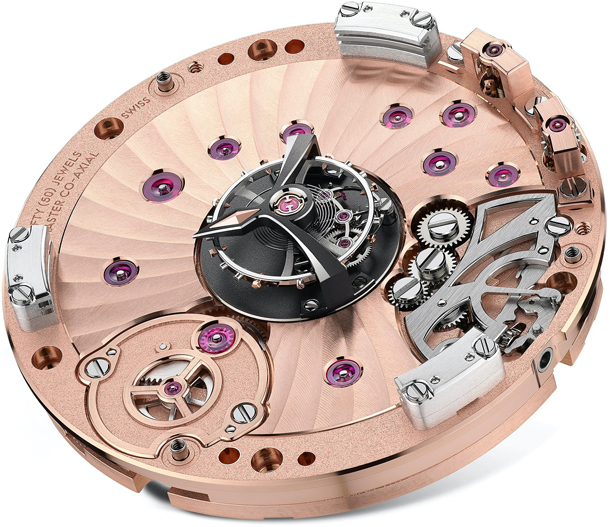
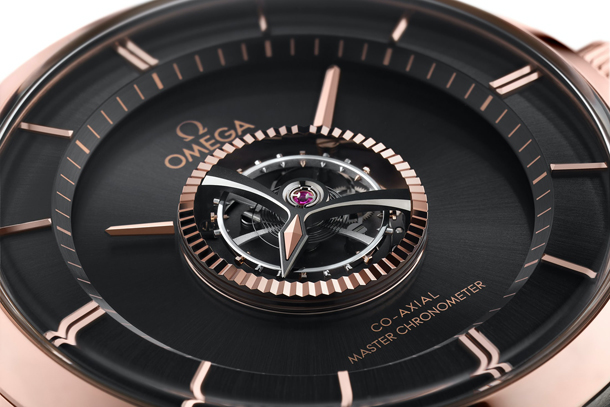
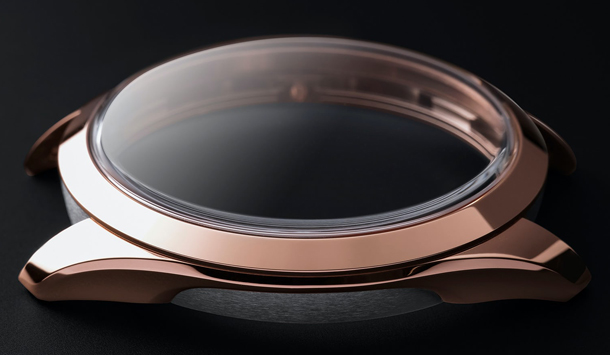
A truncated disk management system with hour and minute indicators is visible from the side of the dial. The drive mechanism is in the one to two o’clock position, and there are three retaining guides for the two discs at twelve, four, and eight o’clock. They have two recesses for two discs. The crown for winding the watch and setting the time is located at 3 o’clock.
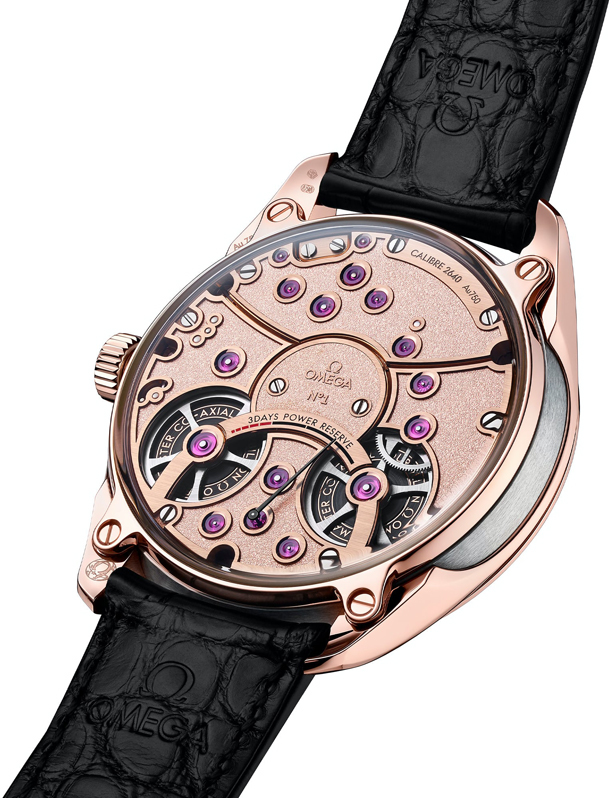
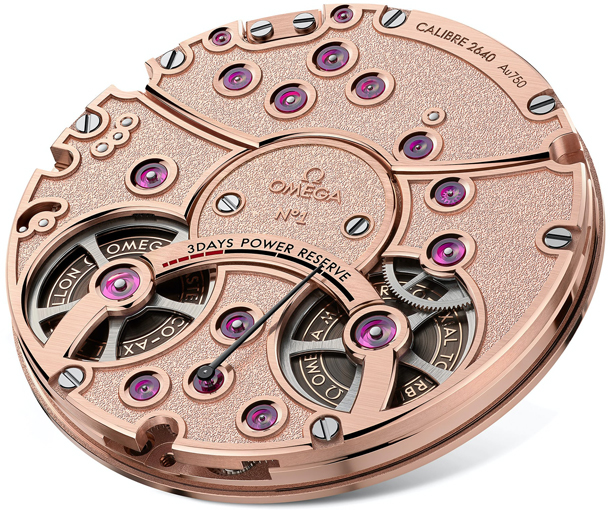
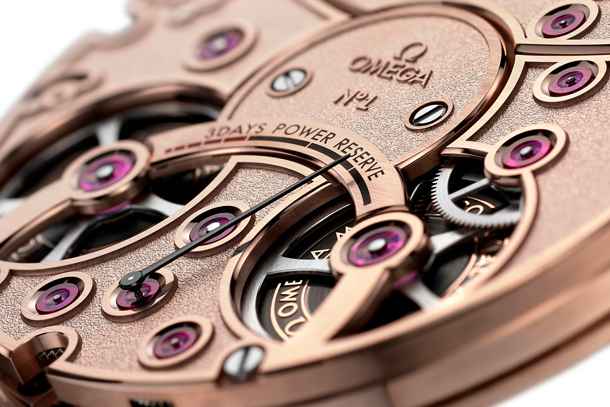
Two barrel-shaped springs are prominently visible in the recesses in the rear of the mechanism. They are visually connected by an arc-shaped bridge, which also acts as a power reserve sector. The original 1994 model was equipped with an automatic mechanism, the new model is presented with a manual winding caliber.
The reels move sequentially, with one on the right ensuring the operation of the central tourbillon, the second supporting the operation of the hour and minute hands. The plate and bridges are made of rose gold. The mechanism in its design and finish resembles both traditional fine finishing techniques and more modern approaches. The use of brushed gold trim rather than the more traditional Geneva waves is a bit like the tradition of English pocket watches. Perhaps this is intended by Omega as an unobtrusive homage to George Daniels, the inventor of the coaxial escapement, but it certainly gives the mechanism a very dignified appearance.
This is the first Omega central tourbillon to receive a Master Chronometer certificate. Omega has managed to create a tourbillon that will continue to work when exposed to extremely strong magnetic fields. The minimum resistance for a certified Master Chronometer watch is 15,000 gauss. The tourbillon carriage is made of ceramic titanium, and the entire mechanism stands on 50 stones. The minute carriage also serves as the second hand for the watch.

The Central Tourbillon De Ville marked a historic moment when it debuted in 1994 to celebrate Omega’s centenary, and remains one of the most revolutionary tourbillon watches of all time. The novelty combines visual interest and subtle facets of technical production. The original brainchild of Moritz Grimm and Andre Beiner has now been significantly updated with Master Chronometer certification and coaxial descent.
Technical specifications Omega De Ville Central Tourbillon
| The building | |
| The mechanism | |
| Price | $168,000 |


- A. Lange & Söhne
- Audemars Piguet
- Bovet
- Breguet
- Breitling
- Bvlgari
- Cartier
- Chanel
- Chopard
- Damiani
- De Bethune
- De Grisogono
- Diamond
- Frederique Constant
- Gerald Genta
- Girard-Perregaux
- Greubel
- Hublot
- IWC
- Jacob & Co.
- Jaeger-LeCoultre
- Louis Moinet
- Omega
- Panerai
- Parmigiani
- Patek Philippe
- Piaget
- Richard Mille
- Roger Dubuis
- Rolex
- TAG Heuer
- Ulysse Nardin
- Vacheron Constantin
- Van Cleef & Arpels
- Zenith
- Reviews