Two-axis armillary tourbillon with bas-relief engraving, referring to the Greek myth of the Pleiades.
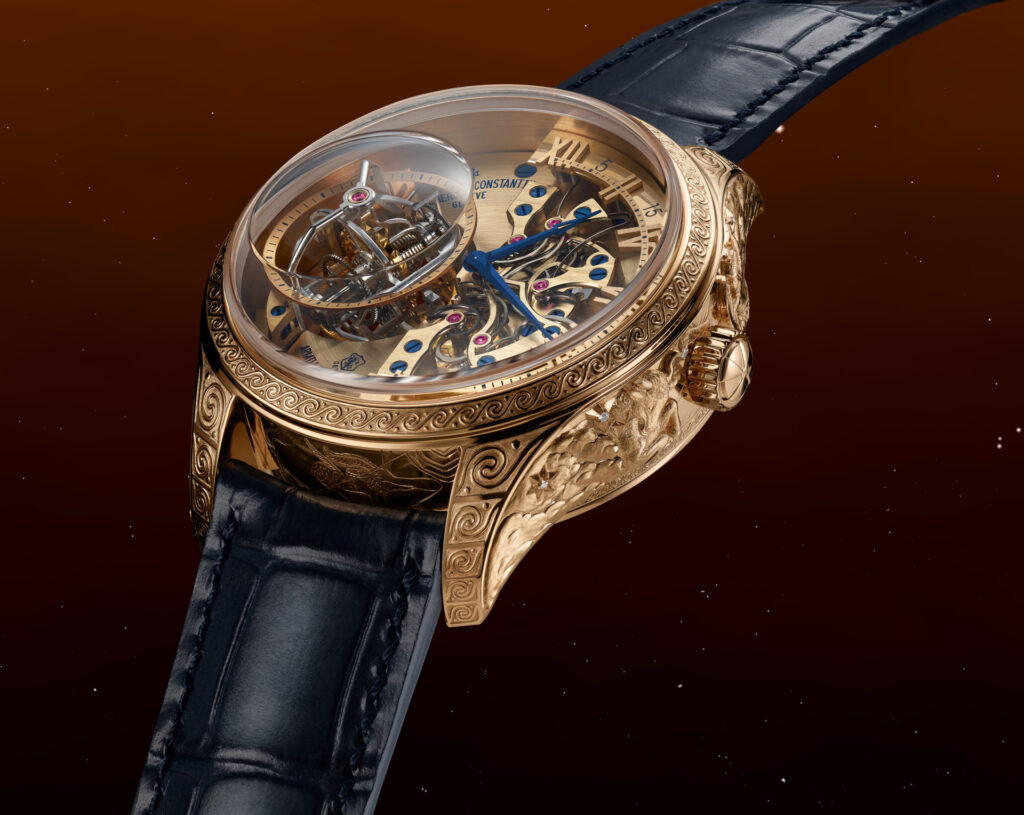
Among the new Vacheron Constantin products presented this fall for the brand’s 270th anniversary, all models are somehow connected with Greek mythology and/or astronomical functions. The model with the telling name Armillary Tourbillon Myth of Pleiades is no exception. The watch is a biaxial armillary tourbillon with bas-relief engraving, referring to the Greek myth of the Pleiades.
In short, the Pleiades is one of the closest and brightest clusters of stars to Earth. It is located in the constellation of Taurus, which is reflected in Greek (and not only) mythology. According to an ancient myth, the Pleiades were the daughters of the titan Atlas and his wife Pleyona. A hunter named Orion fell in love with the seven sisters, who chased them for 7 years, while Atlas, the father of the Pleiades, held the firmament on his shoulders and could not protect his daughters.
The protector of the nymphs was the god Zeus, who sent the Pleiades to the sky, turning them into a constellation. Having lost his prey, Orion went to heaven to get it, but then Zeus again prevented him. He placed a formidable bull with sharp horns between Orion and the Pleiades. Since then, the 7 sisters of the Pleiades have served as celestial sentries and guiding stars for those who embark on sea voyages.
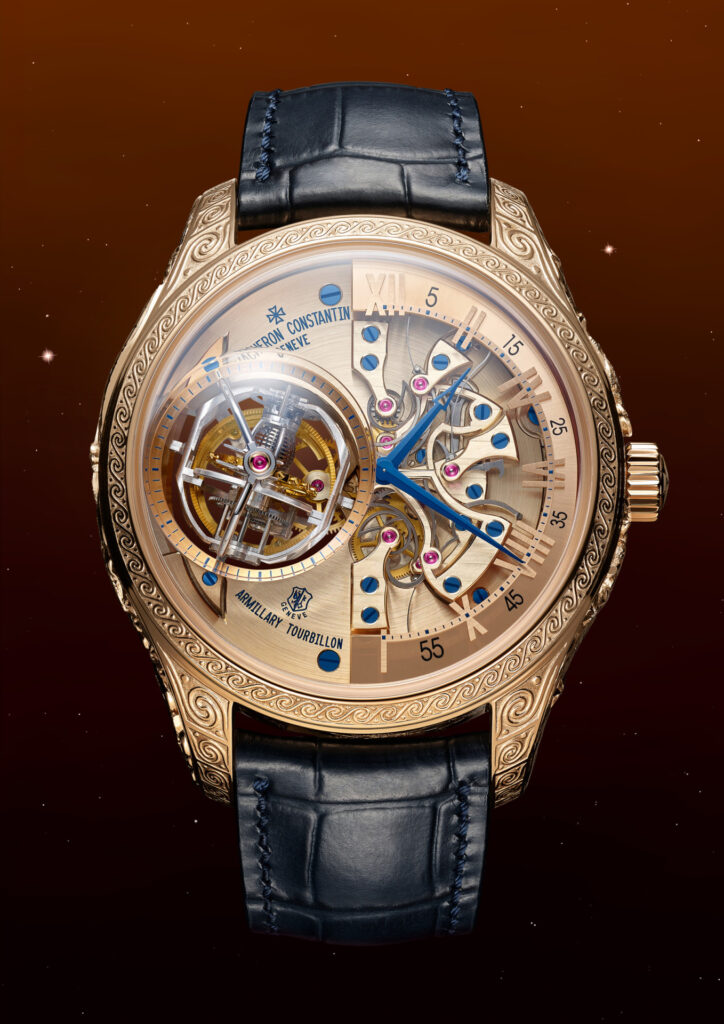
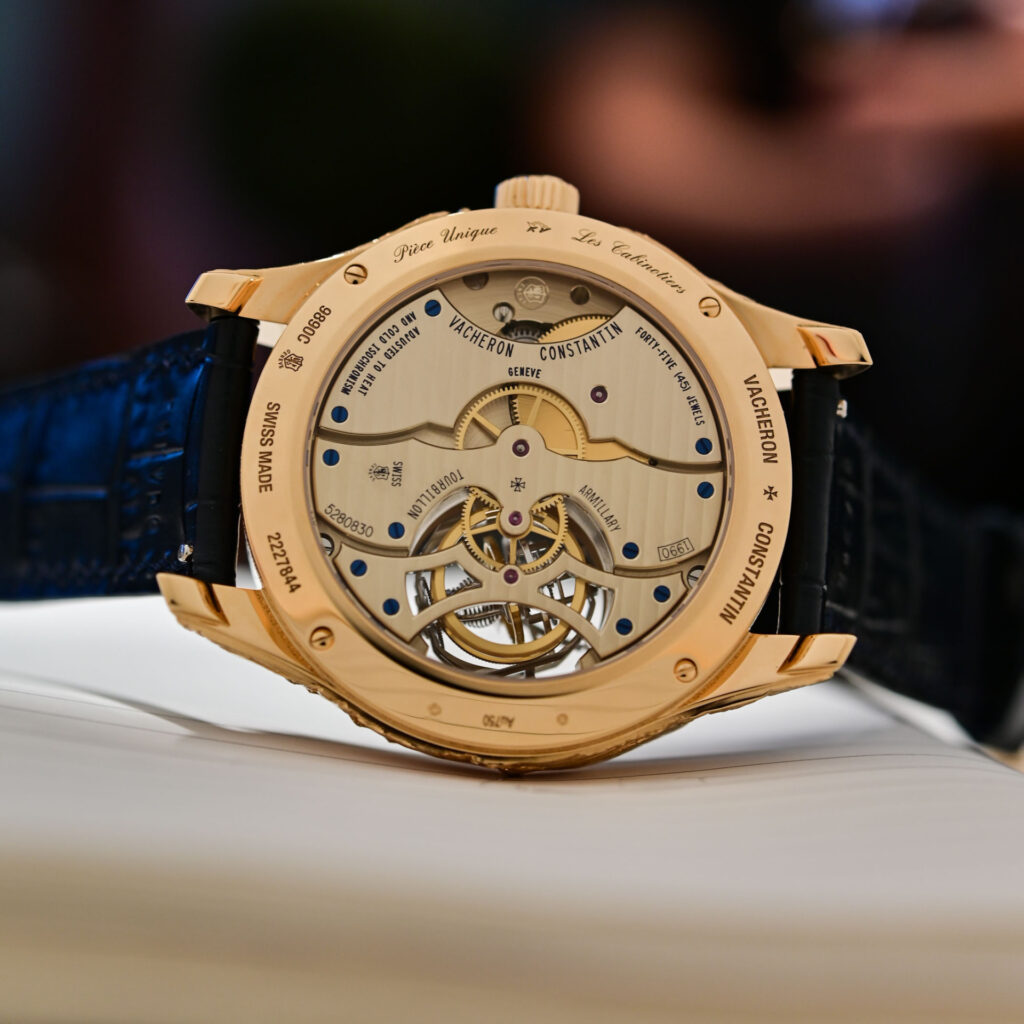
In addition to the marketing component, the watch is admired for its ultra-complex mechanism. The model’s operation is provided by the caliber 1990, which inherited the technical achievements from the famous pocket watch Renférence 57260 with 57 complications. Let me remind you that the latter, until recently, held the title of the most complex watch in the world.
One of these developments is the biregrade indication of hours and minutes with an instant return of the hands to the start. The arrows are made of titanium, which surpasses the standard steel in such cases in strength and lightness. The time is read on a semicircular scale on the right side of the dial, where the hours are indicated by Roman numerals and the minutes by Arabic numerals.
4 patents were obtained for the technical innovations used in the 1990 caliber:
- patent for instant retrograde indication;
- patent for fixing the inner end of the spiral;
- patent for the design of tourbillon carriages. Rotating in different directions, every 15 seconds the carriages form the Maltese Cross, which has been the emblem of the house of Vacheron Constantin since 1880.
- patent for titanium anchor with diamond pallets, which are used to reduce the coefficient of friction.
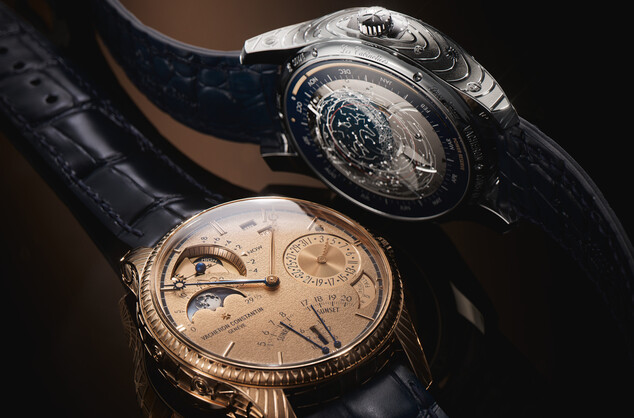
Located under the sapphire dome on the left side of the dial, the armillary tourbillon refers to the work of the 18th-century French watchmaker Antide Janvier. The latter invented a movable sphere that allowed him to explain the apparent motion of the stars. Before the advent of the telescope, the armillary sphere served as a tool for determining the position of stars. The design of the novelty refers to the appearance of this instrument. The aluminum tourbillon carriages built into each other rotate in such a way that they form a sphere in constant motion.
The tourbillon is equipped with a spherical spiral balance, which was invented in the early 19th century and is rarely used in modern watches. This spiral does not have the usual end curves and it gives the tourbillon concentric vibrations, which improves the isochrony of the mechanism. The descent system uses a titanium anchor and diamond pallets. These materials can reduce friction and eliminate lubrication, which increases the durability of the mechanism.
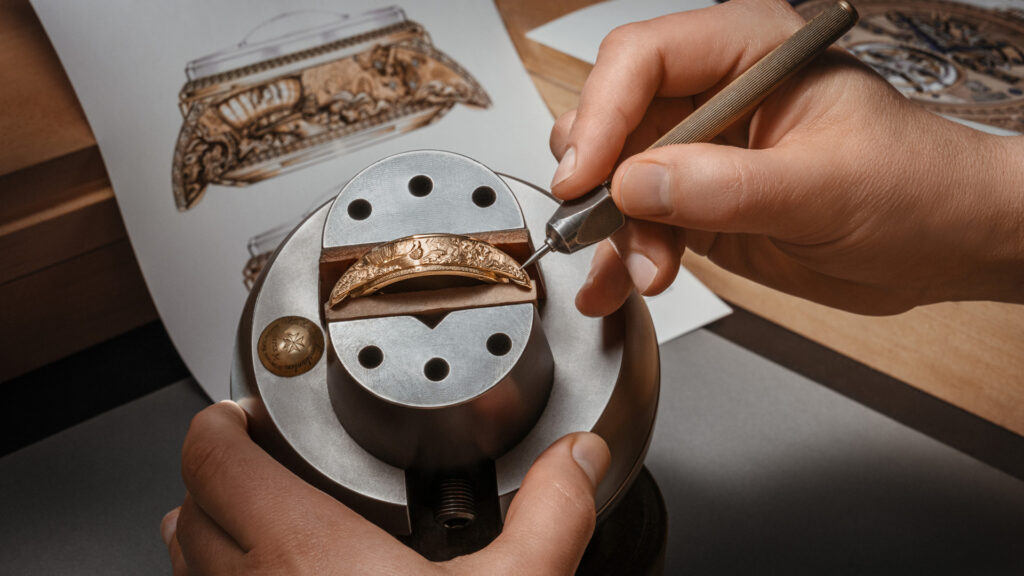
The model is presented in a 45 x 20.13 mm case made of rose gold. The engraving on the watch is inspired by the works of the Polish astronomer Jan Hevelius (1611-1687), to whom the world owes the appearance of one of the first accurate atlases of stars. Orion is depicted in the right part of the body ring with a sword and shield in his hands. It seems that he is ready to fight hand-to-hand with a bull that was sent by Zeus to guard the Pleiades. On the left is the Argo ship with the face of the goddess Athena on the sails. In search of the Golden Fleece, Argo cuts through waves teeming with sea monsters, chimeras and dolphins. His lighthouse is the Pleiades cluster in the constellation of Taurus.
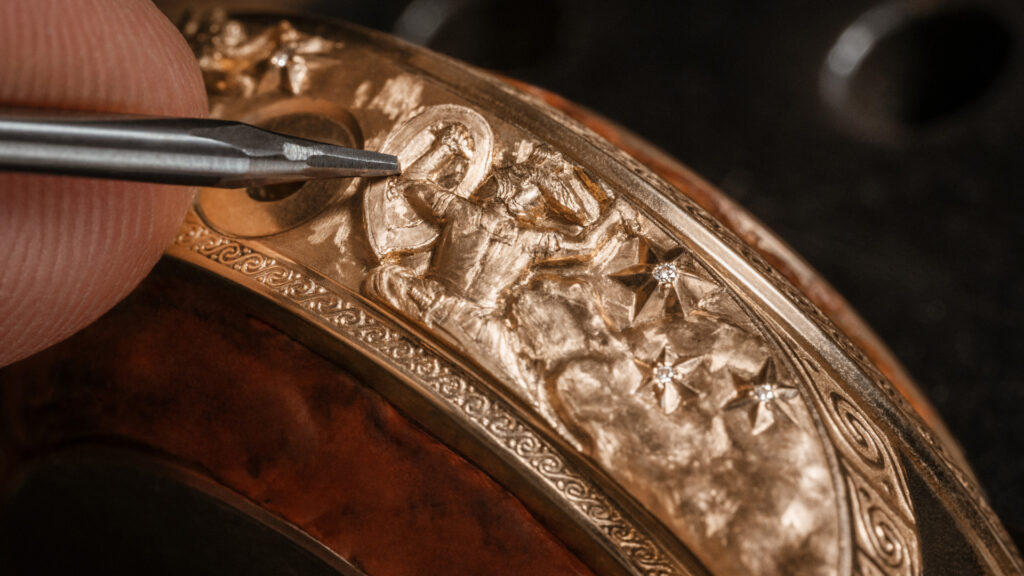
The Pleiades are an open cluster of 3,000 stars, a dozen of which are visible to the naked eye. The role of these stars on the case is played by 10 classic-cut diamonds. The stones of two different sizes (0.6 and 0.9 mm) are distributed as follows: 6 diamonds are encrusted on the side of the crown and 4 more are to the left of it in the sculptural image of Taurus.
Between the ears, the engravers depicted 3 constellations that are located near the Pleiades cluster: the constellations of Aries and Mucha at 12 o’clock and the constellation Gemini at 6 o’clock. The bezel, the ears and the back cover of the case are decorated with a notched engraving in the form of waves in the ancient Greek style. In total, it took 450 hours of work to engrave these watches, which were produced in one copy.

- A. Lange & Söhne
- Audemars Piguet
- Bovet
- Breguet
- Breitling
- Bvlgari
- Cartier
- Chanel
- Chopard
- Damiani
- De Bethune
- De Grisogono
- Diamond
- Frederique Constant
- Gerald Genta
- Girard-Perregaux
- Greubel
- Hublot
- IWC
- Jacob & Co.
- Jaeger-LeCoultre
- Louis Moinet
- Omega
- Panerai
- Parmigiani
- Patek Philippe
- Piaget
- Richard Mille
- Roger Dubuis
- Rolex
- TAG Heuer
- Ulysse Nardin
- Vacheron Constantin
- Van Cleef & Arpels
- Zenith
- Reviews