A two-way clock with two dozen complex functions as a tribute to the founders of the geo- and heliocentric system of the world.

Vacheron Constantin has presented an interesting novelty from the Les Cabinotiers collection. It is a two-way clock with 23 complex functions that honors 2 different concepts of the world: the geocentric concept of Ptolemy and the heliocentric concept of Nicolaus Copernicus.
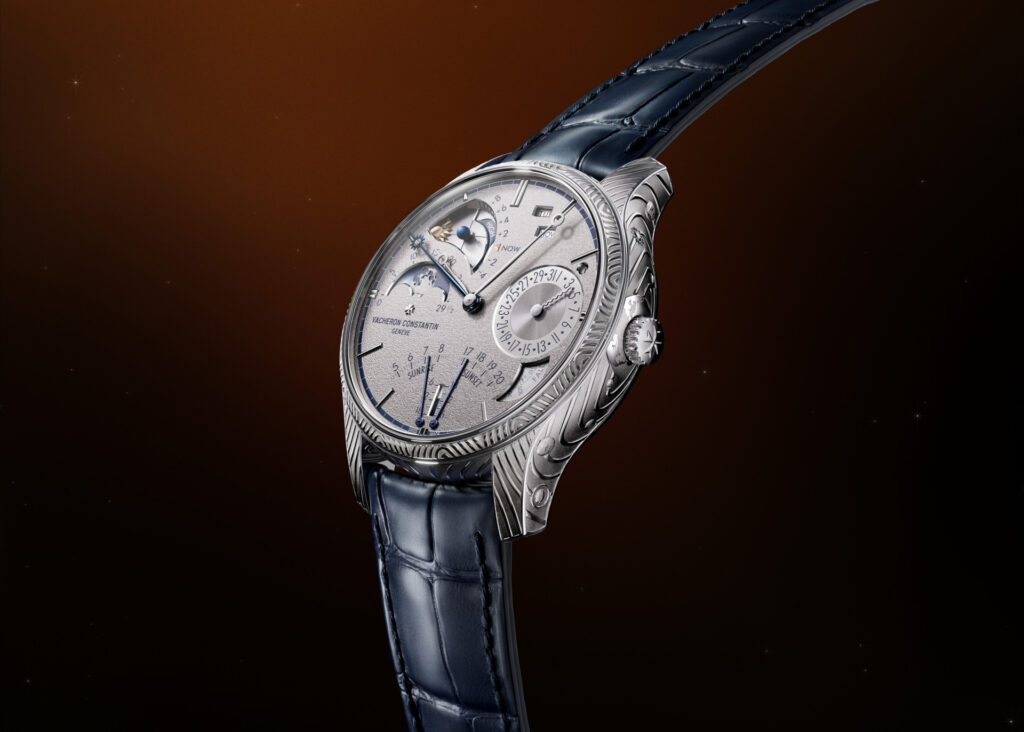
The Celestia Astronomical Grand Complication model displays time in 3 formats: civil, solar and stellar, and each of these displays is equipped with a separate wheel drive. If civil time is the time we live by, then solar time takes into account the elliptical trajectory of the Earth around the Sun and the tilt of the Earth’s axis. Because of this, the real (solar) time is slightly different from the civil one during the year. This difference is shown by a complication called the equation of time. On the watch, it is displayed by an additional minute hand with a sun-shaped tip.
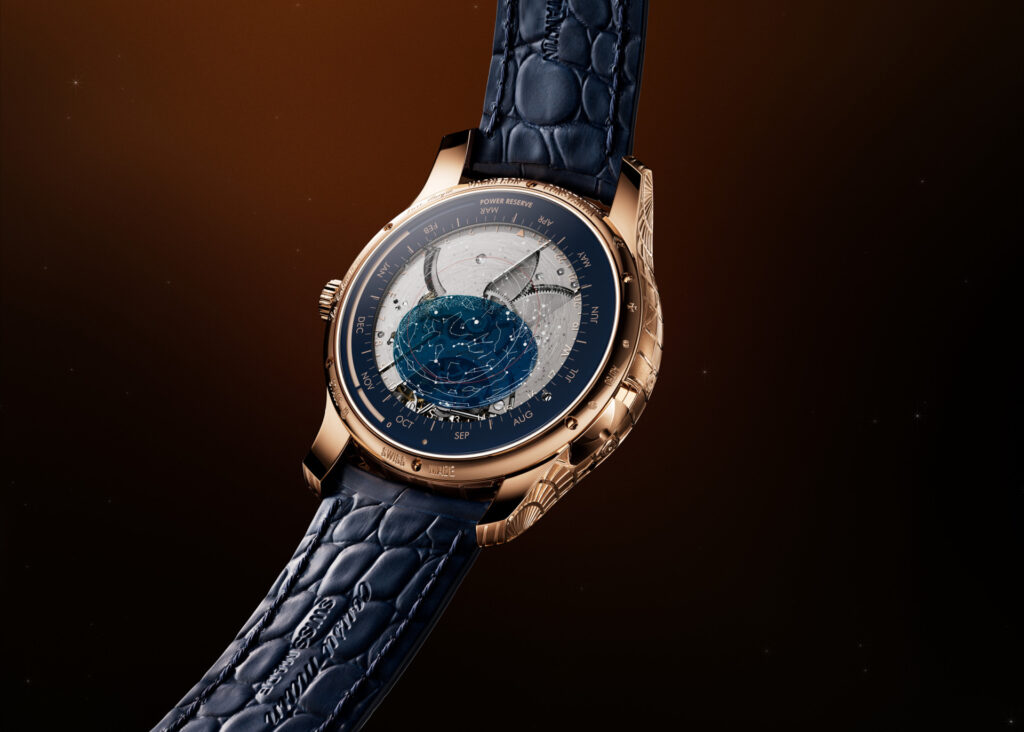
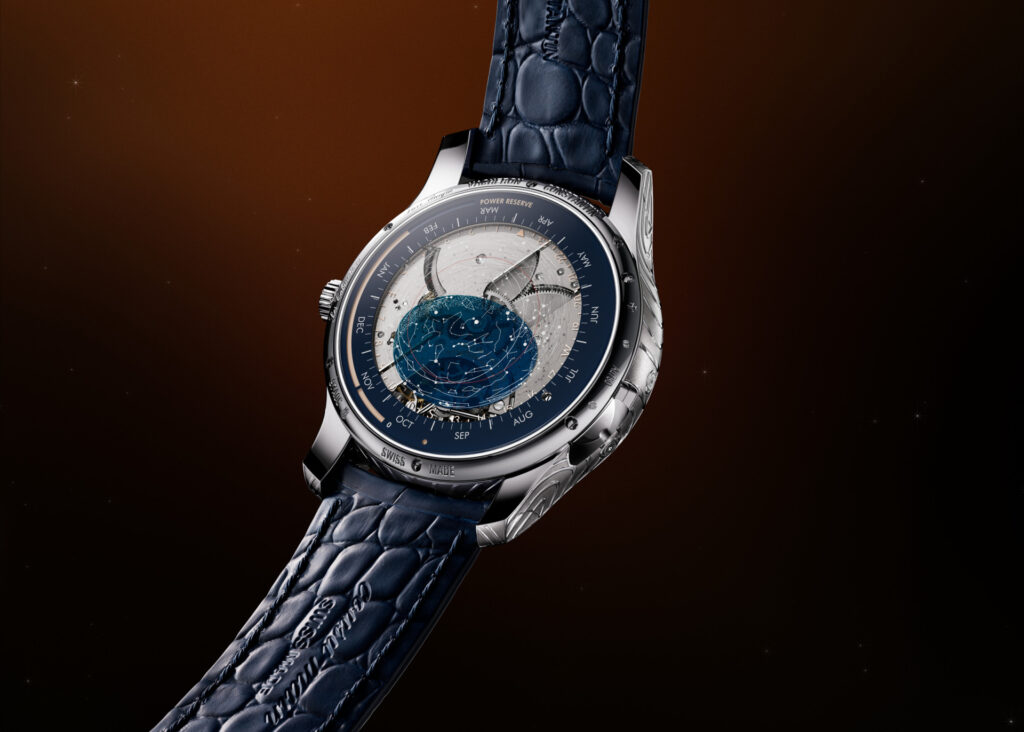
On the back of the watch, on the periphery located on two sapphire discs of the sky map, the sidereal time is displayed. This term is commonly used to mean the time of the Earth’s rotation around its axis relative to a fixed star in the sky. This time is also slightly different from the average civilian day and is 23 hours 56 minutes 4 seconds. The minute marking for displaying sidereal time is located on the periphery of the lower movable disk of the sky map. The current date is displayed here using the yellow triangle.
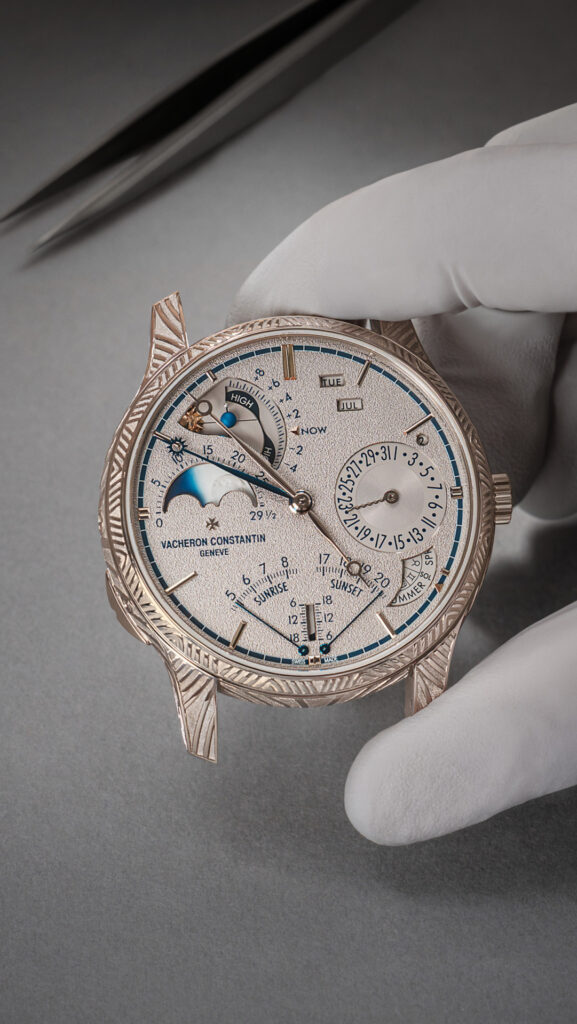
In addition to the civil time and the equation of time, the dial displays the indications of the perpetual calendar: the days of the week and months are read in the windows at the 1 o’clock mark. The date is on the counter at the 3 o’clock mark, where there is also a window indicating the cycle of leap years.
The display of the calendar, programmed to show the exact date until 2100, is complemented by the lunar phases indicator. The two-disc pointer located at the “9 o’clock” mark accumulates a daily error in operation for 122 years. The day/night indicator is also located here, and the age of the moon and the number of days since the last full moon are read on the periphery of the disk.
At the bottom of the dial, on two graduated scales, you can see the time of sunrise and sunset. The duration of the day and night is also read here. The image of the dial is completed by 2 unusual indicators: a rotating disk with the signs of the zodiac, the pores of the year and the days of the equinoxes/solstices, located at 4 o’clock, and a mareograph (tidal indicator), located at 11 o’clock.
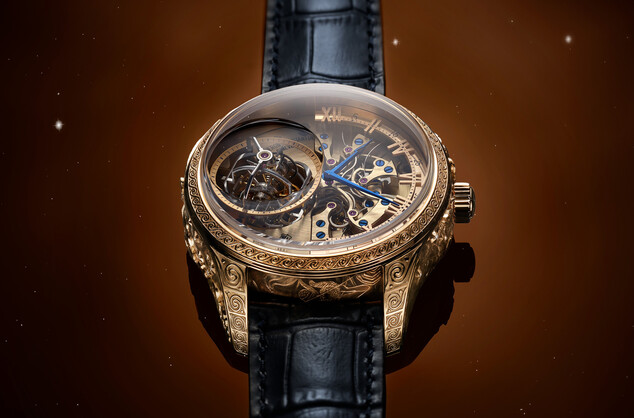
On the back of the watch, you can also find a power reserve indicator, which shows that the movement of the model is designed for 3 weeks of operation without winding. Such a huge reserve of energy is provided by 6 sequentially connected wind-up drums. In order not to overload the dial, a minute tourbillon was placed here. The tourbillon carriage has the shape of the Maltese Cross, which has been the emblem of Vacheron Constantin since 1880.
The watch received a 45 x 13.91 mm case made of white or rose gold. If the dial made of the same metals has a luxurious grained finish, then the case space, including the ears and crown, is decorated with intricate engraving. Depending on the model, references to the geocentric system of Ptolemy and the heliocentric system of Nicolaus Copernicus can be considered in the engraving drawing.
Both models are made in one copy. It took 240 hours of work to engrave each of them.
- A. Lange & Söhne
- Audemars Piguet
- Bovet
- Breguet
- Breitling
- Bvlgari
- Cartier
- Chanel
- Chopard
- Damiani
- De Bethune
- De Grisogono
- Diamond
- Frederique Constant
- Gerald Genta
- Girard-Perregaux
- Greubel
- Hublot
- IWC
- Jacob & Co.
- Jaeger-LeCoultre
- Louis Moinet
- Omega
- Panerai
- Parmigiani
- Patek Philippe
- Piaget
- Richard Mille
- Roger Dubuis
- Rolex
- TAG Heuer
- Ulysse Nardin
- Vacheron Constantin
- Van Cleef & Arpels
- Zenith
- Reviews