STARWHEEL AND THE WANDERING HOUR FUNCTION
The ultra-modern Code 11.59 by Audemars Piguet Starwheel watch, combining black ceramic and 750 white gold, offers a new look at the traditional complexity of the wandering watch.
On this occasion, the Audemars Piguet brand launched a collaboration with the French artist Hugo Gattoni, who created an original, colorful and fantastic universe, where he tried to reflect the modern design of this watch and the mystical nature of the wandering clock technique.

ULTRA-MODERN
AN APPEAL TO THE PAST
The wandering hour function, invented in the 17th century, is a clock complication that has changed the way time is displayed: the hour indicators rotate along the arc-shaped minute scale. Such an aesthetic representation of hours and minutes brings a certain mystery to the perception of time.
In the 20th century, this complication lost popularity, but it was rediscovered and reintroduced in 1991 by the Audemars Piguet brand. The unusual mechanism, called the “Starwheel”, was used in many models until the early 2000s.

Today, the Starwheel feature returns to us in the Code 11.59 by Audemars Piguet collection, the state-of-the-art design of which perfectly reveals the appeal of this display system, which belongs to the classics of Fine watchmaking, although relatively little known.
THE STARWHEEL UNIVERSE IN a NEW
INTERPRETATIONS BY HUGO GATTONI
The launch of the new Code 11.59 by Audemars Piguet Starwheel model is accompanied by a presentation of a unique universe created by French artist Hugo Gattoni. This talented illustrator shares many values with Audemars Piguet, including freedom of thought and attention to detail. This helped him create a poetic and rather funny world in which three Time Lords on rotating disks move through intergalactic space, where the elements of Starwheel complexity also move in orbits. Together, they assemble these elements into a single clockwork mechanism, synchronizing their movement.

ROTATING TIME INDICATOR
The time is indicated using a rotary device located in the center, which makes a complete revolution in three hours and on which three aluminum discs are fixed, which also rotate around their own axis. Each disc has 4 digits, covering the total range from 1 to 12. These numbers alternately turn out to be directed at the arc in the upper part of the dial, on which the minute scale is applied. The central 750-proof white gold second hand, slightly curved at the end to bend around the convex shapes of the discs, shows seconds, as in a traditional watch. The discs rotate like planets in the small universe of the dial on a sparkling background of blue aventurine.
PLAYING WITH MATERIALS
With a diameter of 41 mm, this new reference beats the original combination of materials: the aventurine dial and the case, which combines 750 white gold and black ceramics. This variety of materials, as well as the exquisite hand-made finish that creates an endless play of light, highlight the intricate design of the Code 11.59 by Audemars Piguet collection.
On the front side, the double-curved sapphire crystal highlights the numerous details on the blue aventurine surface, as well as the decoration of various elements, making the depth of the dial more expressive.
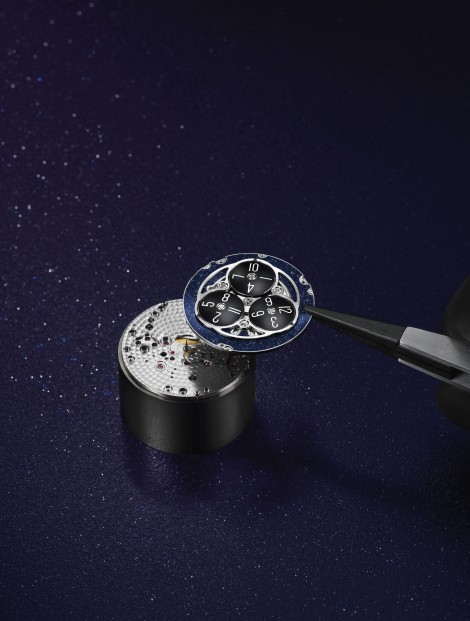
WATCH MOVEMENT WITH STARWHEEL FUNCTION
The iconic Starwheel feature has now been implemented for the first time in the Code 11.59 by Audemars Piguet collection of 4310 caliber watches with automatic winding. This new-generation movement with an indication of hours, minutes and seconds, combining advanced technologies, traditional techniques and exquisite finishes, is a direct continuation of the Caliber 4309, to which an additional module has been added.

The wandering clock function was invented in 1655 by order of Pope Alexander VII, who suffered from insomnia aggravated by the ticking of the clock, and rediscovered by Audemars Piguet in 1991 as a unity of history, technical complexity, design and poetry.
Sebastian Vivas
Director of the Audemars Piguet Heritage and Museum Department
Source: https://www.audemarspiguet.com/com/ru/watch-collection/code-1159/15212NB.OO.A002KB.01.html

