It took Greubel Forsey about 20 years to create this brand new watch piece at an affordable price with a vibrant personality. To do this, the Workshop had to start from scratch. How to make a watch of the usual diameter, in which it would be possible to embed a manufacturing mechanism so that it also “breathes”? How can I make watches more affordable if they are 100% hand-made? The creators of Balancier 3 managed to cope with this difficult task.
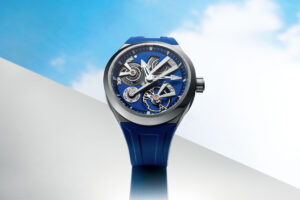
First, about the style. The novelty is distinguished by three bridges: a wind-up drum, a large balance and a key that runs through the entire mechanism, communicates with the seconds indicator and serves as a support for the hour and minute hands. Each of the bridges is decorated in the best traditions of Greubel Forsey hand finishing: convex polished surfaces, polished chamfers and hand-polished screws. The presence of incoming angles and curved shapes in each bridge further complicates the work of the master, which requires extreme scrupulousness. Collectors will appreciate it.
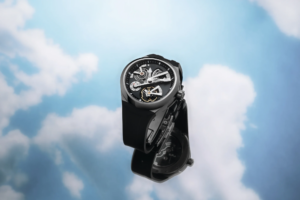
The new architecture represents a further development of the Convexe collection. The already famous body of the Le Balancier 3 is also made thinner here. For the first time, Greubel Forsey’s wristband fasteners do not have screws. The Convexe case, a unique creation of High Watchmaking, has a convex shape both on the back cover and on the dial side. The watch fits very comfortably on your hand, as its shape echoes the curve of your wrist. The double deep bend to the halves of the bracelet from the side of the dial forms architecturally strict volumes into which the mechanism is inscribed.
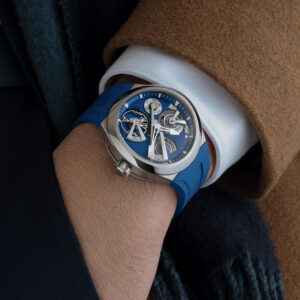
Now about the mechanism. It gives the watch a dynamic modern style, ensures impeccable chronometric qualities and at the same time makes this model the most affordable in the Greubel Forsey collection. The rich experience of Greubel Forsey employees has once again helped achieve this goal. The idea was to build a restrained, concise, modern architecture that allows you to admire the finish of each of the components of the mechanism.
For this purpose, the Workshop paid special attention to the technical composition of its watches, namely, the energy source and the oscillation regulator. Wind-up drums and great balance. The key components of the countdown. Both wind-up drums are located in the upper part of the bridge and rotate serially in turn at high speed (one revolution per 3.2 hours). Their graphic design, imbued with the idea of rotation, is increasingly being used in the Convexe collection. In total, the reels provide three days of chronometrically accurate clock running. After that, the watch will be able to work for some more time, but beyond the margin of error allowed by Greubel Forsey.
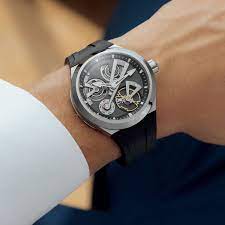
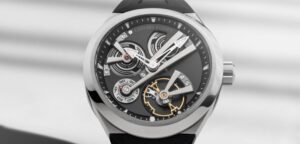
The power reserve is indicated on the back of the case, another innovation in the Convexe collection. There is a large balance between the “4 o’clock” and “6 o’clock” positions, which determined the name of the model. In the flat position, its variable moment of inertia is regulated by six gold screws. It takes full advantage of its 12.6 mm diameter, created in the Workshop, which is one of the largest in modern watchmaking. Its vibrations echo the fixed small second hand at the “8 o’clock” position: it is not the hand itself that rotates, but the manually satin-finished disc that carries it.
And finally, the finish. Its most striking example is a large bridge holding the hands of the hours and minutes. The openwork one, placed on three levels and curved in three dimensions, with many incoming angles, continuing with a finely crafted protrusion reaching up to a small second hand, is a real engineering achievement. The hand-finished level corresponds to the extremely complex geometry of its shapes. No less complex is the shape of the wind-up drum bridges and the large balance, the curved lines of which echo the convex hull. The Balancier 3 model with a diameter of 41.5 mm is available in two versions in black and blue, with 88 copies each, with a rubber strap or a titanium Greubel Forsey bracelet (on request).

